
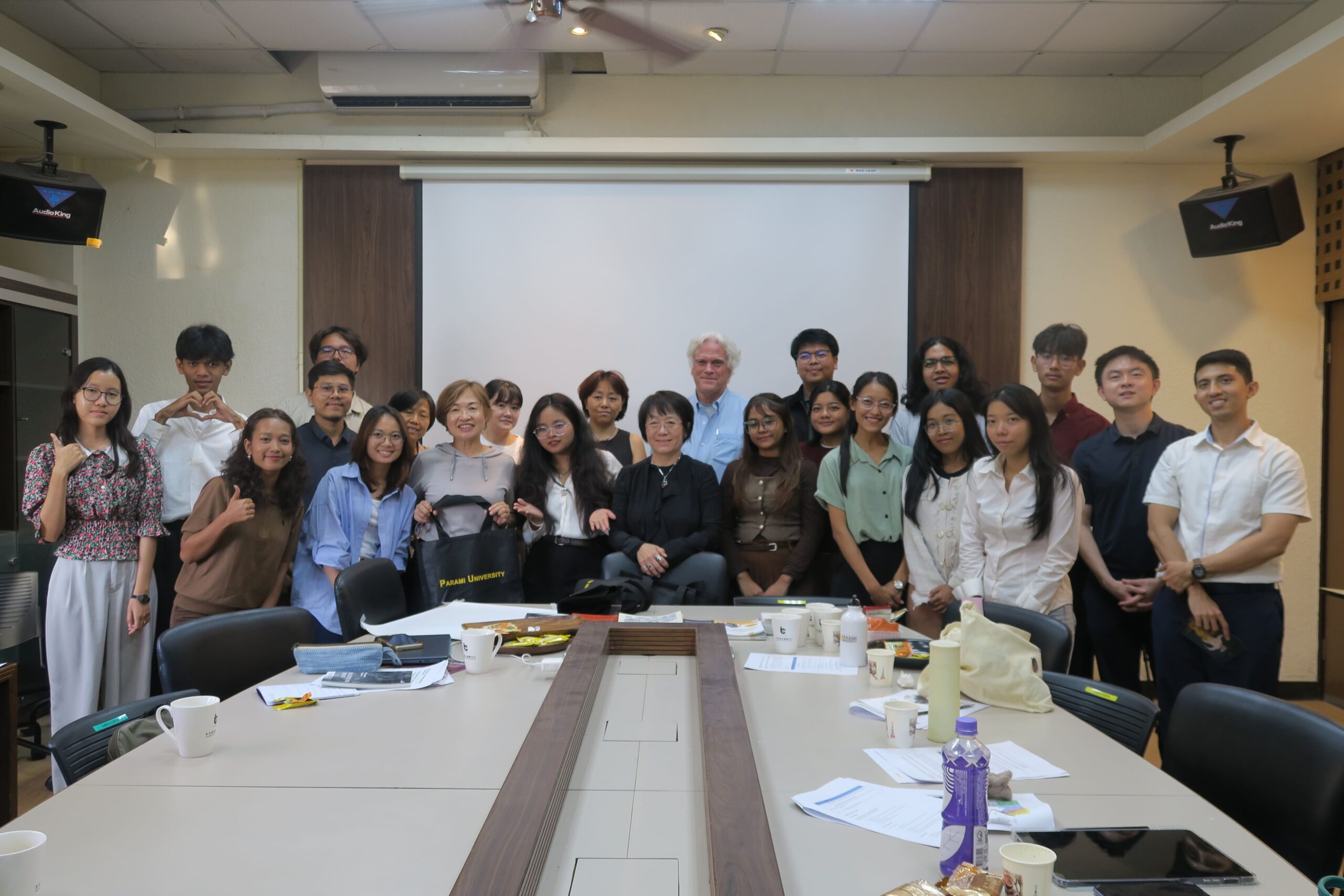
側記|跨越疆界的教育與人權對話ICCS-Parami Dialogue
日期時間 Date and Time|2026年8月4日14:00-17:00
地點 Venue|國立陽明交通大學 光復校區 人社三館HC104教室
主持人 Moderator|劉紀蕙(國立陽明交通大學社會與人文研究所榮譽退休教授暨文化研究國際中心主任)
講者 Speaker|劉紀蕙(國立陽明交通大學社會與人文研究所榮譽退休教授暨文化研究國際中心主任)、潘美玲(國立陽明交通大學人文社會學系教授)、卓瑪.慈仁(Dolma Tsering)(國立陽明交通大學文化研究國際中心博士後研究員)、彭霓霓(國立暨南國際大學東南亞學系博士)、Dan Wessner(帕拉米大學社會科學與人文學院教授暨大學合作與拓展主任)、賴彥蓉(台灣人權促進會難民議題專員)
側記作者 Writer|陳光語(國立陽明交通大學人文社會學系族群與文化碩士班學生)
Opening and Introducing the ICCS(講者:劉紀蕙)
劉紀蕙主任歡迎Parami University的師生們到來,並簡單說明本場活動的議程與規劃。文化研究國際中心(ICCS)作為國立陽明交通大學重要的學術組織,致力於推動「衝突、正義、解殖:21世紀轉型中的亞洲」相關研究。中心涵蓋地緣政治與文化經濟、數位治理、遷徙與不平等公民權、環境危機與多物種正義,以及藝術社會干預等核心領域,並透過跨院系合作與旗下的「亞際轉型研究網絡(TARN)」連結國際學術社群。劉主任邀請大家持續關注文化研究國際中心的網站、訂閱電子報,並勉勵Parami University的同學投稿至《Conflict, Justice, Decolonization (CJD)》線上期刊,有任何想要了解的中心的內容都歡迎與我們聯繫。
Introducing the ICCS Subproject III Research Group “Refugee and Statelessness”(講者:潘美玲)簡報檔
潘美玲教授介紹自己是一名經濟社會學家,因緣際會下進入印度開始研究流亡藏人,投入難民研究領域將近二十年。潘教授以印度流亡藏人的毛衣市場研究[1]為例,如何透過實地研究,理解無國籍者的身分處境,並看見難民身處不同環境當中藉著社會網絡展現其韌性所在。潘教授今年在本中心成立的子計畫三研究群:難民與無國籍,邀集國內外相關研究學者,開展學術成果分享與議題倡導。該研究群致力於四大研究議程:學術研究與出版、國際交換與政策倡議、社會實踐與公眾意識、教學與人才培育。研究群透過舉辦多場活動,例如嘉洛博士〈中共殖民式寄宿制學校教育與西藏文化傳承前景的社會學解讀〉與薩瑪達博士〈難民經濟中的勞動主體〉的講座、難民研究青年學者工作坊等等,持續引領公眾對於無國籍與難民議題的關注。
Research Presentation: Statelessness, Migration, and Academic Engagement(講者:卓瑪.慈仁(Dolma Tsering))
身為在印度出生長大的第二代圖博人,卓瑪.慈仁博士刻意採用「無國籍圖博難民」(stateless Tibetan refugee)詞彙以精確反映其法律現實。她解釋道,由於印度並不是《難民地位公約》與《難民地位議定書》的締約國,圖博人受限於國內的法律框架,且主要依據出生年份與地點進行分類。1962至1987年間於印度出生的圖博人具備申請公民身分的基礎,包含她本人在內的1987年後出生者則遭到排除。後者在印度的居留身分完全取決於須定期親辦展延的「登記證」(Registration Certificate, RC);跨境移動更受到嚴格限制,須同時取得「身分證明」(Identity Certificate, IC,即黃色旅行文件)以及「無異議返印證明」(No Objection to Return to India, NORI)等繁複授權。
回顧在台六年的生活經驗,卓瑪.慈仁博士指出台灣同樣缺乏難民法。儘管經過多年的交涉與抗爭,她最終取得了「外僑居留證」(Alien Resident Certificate, ARC),然而無國籍難民的困境不僅止於合法居留,更涉及醫療與就業等基本生存權。她綜合上述經驗提出以下學術批判:無國籍狀態是透過跨越疆界的法律與行政實踐,不斷被複製的「跨國處境」(transnational condition)。無國籍者往往未被視為經歷法律與社會脆弱性的個體,反而被「安全化」(securitization)視角建構為潛在威脅。這些持續對證件展延與旅行許可的要求,築起了系統性的制度障礙,使在海外定居的圖博人也持續受到限制。
Short Brief about Myanmar in Taiwan(講者:彭霓霓)簡報檔
身爲親身經歷過2007年袈裟革命的緬甸華僑,彭霓霓博士首先分享自己在台求學的經歷,並向大家介紹緬甸人與緬甸籍留學生在臺灣的現況。藉著引述教育部統計指出,近年在台緬甸籍留學生人數呈現顯著成長,從109學年度的928人大幅增加至113學年度的2,973人,其中僑生占2,200人,外籍生為773人。在入學管道上,高等教育主要透過海外聯合招生委員會與各大學獨立招生,高中以下亦有僑委會招生管道,並配合學制參考名冊與學歷採認機制。此外,彭博士也梳理了臺灣各地多元的緬甸移民社區與在地文化,包含新北緬甸街的潑水節、桃園中壢龍岡米干節、南投清境火把節及屏東里港等滇緬特色聚落。最後,彭霓霓博士拋出「誰是緬甸在臺灣的移民」的深刻提問,說明包含國軍眷屬(泰緬孤軍)、華僑、僑生與新住民等多重身分,展現出國族歷史認同與多元遷徙脈絡交織的特殊性。
Speech by students from Parami University(講者:Dan Wessner、Parami University 的學生們)
Dan Wessner教授負責這次帶領14位學生的國際交流活動,提到本次交流會前分別在國立中山大學與台北進行活動。學生們共同提及,Parami University目前是全面線上授課的學程,因此很多學生在這次的國際交流活動之前,過去僅在線上的課堂聊天室見過面,來自不同背景與地區的同學,是在這次活動才認識到彼此。即便他們已經參與活動多日,這也是他們首度有機會分享自身的生命敘事,他們非常感謝中心、Dan Wessner教授、Aung Myin Thu主任一同促成這次的機會,讓他們在這個溫暖、安全的空間彼此交流,給予彼此向前走的動力。
學生們指出緬甸傳統教育體制的問題,其本質為禁止提問、要求絕對服從的「填鴨式教育」。在2021年軍事政變後,參與公民不服從運動成為青年抵抗國家暴力的途徑,卻也讓他們失去了受教權與官方身分(名字遭軍政府控制的學校註銷),甚至因戰火成為國家內部的流亡者。此外,女性學生們點出她們承受著家族內部父權觀念的交織性貶抑,例如被認為女性應盡早進入婚姻、追求高等教育是浪費時間,甚至被親人質疑線上大學是「詐騙」而深陷孤立。面對上述困境,學生們的核心關懷展現了從「實用主義」向「公民參與」的顯著轉變。起初,多數人僅是為了在職場生存而渴求一紙文憑。然而,接受博雅教育後,他們開始反思社會衝突的根源,並將哲學、經濟學與資料科學等專業學科視為分析與解決社會問題的工具。學生們強烈渴望藉著教育將自身轉化為改變社會的「園丁」,將批判性思考帶回社區與基層教育中,並讓改變在生活中逐漸發生。
An Overview of Refugee Situation in Taiwan(講者:賴彥蓉)簡報檔
身為台灣人權促進會(TAHR)的倡議者,賴彥蓉專員指出我國在人權公約承諾與國內庇護實踐之間的巨大斷裂,並在近期新版國家人權行動計畫草案更移除了《難民法》立法這項關鍵指標 [2],而國內《難民法》的立法更是延宕逾二十年。她表示,在缺乏合法身分的情況下,難民群體不僅面臨被拘留與強制遣返的威脅 [3],更被系統性地剝奪了合法工作、就醫、租屋與簽署法律合約等基本生存權利。賴專員藉由過去接觸緬甸籍留學生的經驗指出,在缺乏法律保障的狀態下,許多尋求庇護的緬甸青年被迫陷入脆弱的處境,緬甸籍留學生也可能在資訊不對等的情形下背負高額債務來台。賴專員提到在部分新南向產學合作專班的爭議當中,學生以實習名義面臨勞動條件不佳的風險,而部分學生因長時間實習、工讀與語言門檻等因素而「不得不曠課」。賴專員在結語時呼籲,我國社會應重視過去戒嚴時期推動台灣民主運動的前輩們曾受惠於國際庇護的歷史,主動承擔起人權保護責任,並建立完善的法律體系以保障尋求庇護者的基本權利。
Open Discussion
Dan Wessner教授首先以「Parami is not a scam!」來回應那些質疑Parami是虛假機構的聲音,並指出這場對話為學生們提供了情感宣洩與表達的空間,期盼未來能持續深化與文化研究國際中心的學術夥伴與合作關係。劉紀蕙主任則強調,面對國家暴力帶來的集體創傷,受壓迫者不能壓抑或迴避,而必須直面歷史;也勉勵學生們透過持續的閱讀、批判性研究與知識生產(如參與CJD線上學術期刊發表)來賦權自身。劉紀蕙主任呼籲跳脫單一國家的公民身分框架,透過跨越疆界的社會連帶,共同培育未來重建母國基層社會的學子們。潘美玲教授則以台灣長達38年戒嚴與民主化的歷史為借鏡,希望作為緬甸青年們對抗威權的歷史參照對象,展現出民主制度仍具有重建的可能性。彭霓霓博士則從實務視角切入,指出我國與緬甸之間存在某種互利合作的空間:我國為流離失所的緬甸青年提供教育庇護,而這些學生則透過其多元化背景和社會參與,豐富了高等教育的格局和視野,同時滿足緬甸青年迫切的避難與教育需求,若同學們有相關的規劃都歡迎聯絡自己。這些論述都帶領我們思考,如何在尊重國內法治與人權價值的基礎上,發揮跨國學術共同體的社會責任,將教育空間轉化為對抗威權敘事、撫平集體創傷,並為未來的民主化儲備社會資本的關鍵基地。
註釋
[1] 潘美玲,2011,〈流離的道德經濟:流亡印度的藏人毛衣市場與協會〉。《臺灣社會學刊》 46:1–55。link
[2] 行政院人權資訊網,2026,〈02.新版國家人權行動計畫人權議題篇章(草案).pdf〉。https://www.ey.gov.tw/hrtj/83E5FBBD47B54AE4/0ad87440-7a14-4cd8-a8a9-7dc7be0a6104?shem=rimspwouoe,取用日期2026年9月24日。
[3] 賴專員提到,即便近年政府積極推動兩公約國際審查會議與人權行動計劃,但實質進展仍舊有限。例如,現行雖有針對尋求庇護的緬甸人,採取依個案審查並核發「臨時外僑登記證」的行政措施;然而,在台灣人權促進會實際協助個案申請後,卻發現至今尚無成功核准的案例。
Sidelights | Education and Human Rights Dialogue Across Borders: ICCS-Parami Dialogue
Sidelights | Education and Human Rights Dialogue Across Borders: ICCS-Parami Dialogue
Date and Time | August 4, 2026, 14:00-17:00
Venue | Room HC104, Humanities and Social Sciences Building III, Kuang-Fu Campus, National Yang Ming Chiao Tung University
Moderator | Joyce C.H. Liu (Professor Emeritus, Institute of Social Research and Cultural Studies, and Director of the International Center for Cultural Studies, National Yang Ming Chiao Tung University)
Speakers | Joyce C.H. Liu (Professor Emeritus, Institute of Social Research and Cultural Studies, and Director of the International Center for Cultural Studies, National Yang Ming Chiao Tung University), Mei-Lin Pan (Professor, Department of Humanities and Social Sciences, National Yang Ming Chiao Tung University), Dolma Tsering (Postdoctoral Researcher, International Center for Cultural Studies, National Yang Ming Chiao Tung University), Ni-Ni Peng (Ph.D., Department of Southeast Asian Studies, National Chi Nan University), Dan Wessner (Professor of Division of Social Science and Humanities & Director of University Partnerships and Engagement, Parami University), and Yen-Rong Lai (Refugee Issue Specialist, Taiwan Association for Human Rights)
Writer | Loinnir Chen (Master’s Student, Graduate Program of Ethnicity and Culture, Department of Humanities and Social Sciences, National Yang Ming Chiao Tung University)
Opening and Introducing the ICCS (Speaker: Joyce C.H. Liu)
Director Joyce C.H. Liu welcomed the arrival of the faculty and students from Parami University, and briefly explained the agenda and planning of this event. As an important academic organization of National Yang Ming Chiao Tung University, the International Center for Cultural Studies (ICCS) is committed to promoting research related to “Conflict, Justice, Decolonization: Asia in Transition in the 21st Century.” The center encompasses core fields such as geopolitics and cultural economy, digital governance, migration and unequal citizenship, environmental crises and multispecies justice, and artistic social interventions, and connects with the international academic community through interdisciplinary collaboration and its “Trans-Asian Research Network (TARN).” Finally, Director Joyce C.H. Liu also invited us to continue following the website of the ICCS, subscribe to our newsletter, and urged the students from Parami University to submit articles to the online journal “Conflict, Justice, Decolonization (CJD)“; they are welcome to contact us regarding any content of the center they wish to learn about.
Introducing the ICCS Subproject III Research Group “Refugee and Statelessness” (Speaker: Mei-Lin Pan)
Professor Mei-Lin Pan introduced herself as an economic sociologist who fortuitously entered India to begin researching exiled Tibetans, and she has devoted refugee studies for nearly twenty years. She took her research on the sweater market of exiled Tibetans in India [1] as an example to illustrate how, through field research, one can understand the identity and circumstances of stateless persons, and observe how refugees demonstrate their resilience through social networks across different environments. Subproject III Research Group “Refugee and Statelessness” was established by Professor Pan at this center this year, inviting relevant domestic and international scholars to initiate the sharing of academic achievements and issue advocacy. The research group is dedicated to four major research agendas: academic research and publication, international exchange and policy advocacy, social practice and public awareness, and teaching and talent cultivation. By organizing multiple events—such as Dr. Gyal Lo’s lecture on “A Sociological Analysis of CCP Colonial Boarding Schools and the Future of Tibetan Cultural Preservation,” Dr. Samaddar’s lecture on “The Labouring Subject of Refugee Economies,” and the Young Scholars’ Workshop on Refugee Studies—the research group continues to lead public attention toward the issues of stateless populations and refugees.
Research Presentation: Statelessness, Migration, and Academic Engagement (Speaker: Dolma Tsering)
As a second-generation Tibetan born and raised in India, Dr. Dolma Tsering shared her lived experiences as a “stateless Tibetan refugee”, deliberately adopting the term to accurately reflect their legal reality. She explained that in India—which is neither a party to the 1951 Refugee Convention nor its 1967 Protocol—stateless Tibetan refugees are governed by domestic frameworks and categorized primarily by their year and place of birth. To elaborate, while Tibetans born in India between 1962 and 1987 have a legal basis to claim Indian citizenship, those born after 1987, including Dr. Tsering herself, face different statutory exclusions. Consequently, everyday legal status in India hinges on the Registration Certificate (RC), which requires periodic, in-person renewals to avoid jeopardizing lawful residence. Moreover, international mobility is severely restricted: traveling abroad requires an Identity Certificate (IC, or yellow travel document) alongside a No Objection to Return to India (NORI) permit, making cross-border travel a complex process of securing both departure and re-entry authorizations.
Reflecting on her six years in Taiwan, Dr. Tsering noted that Taiwan similarly lacks a comprehensive refugee law. Although she eventually secured an Alien Resident Certificate (ARC) after years of negotiations and contestations with government authorities, she emphasized that the predicament of stateless refugees extends beyond legal residency to basic survival rights, such as access to healthcare and employment. Synthesizing these experiences, Dr. Tsering offered a broader academic critique of how statelessness operates as a “transnational condition” reproduced through legal and administrative practices across borders. Rather than being recognized as individuals experiencing profound legal and social vulnerability, stateless people are frequently subjected to a lens of “securitization,” where they are constructed as potential state threats. These perpetual demands for document renewals and travel permissions construct systemic institutional barriers that continue to constrain displaced Tibetans even after establishing long-term lives abroad.
Short Brief about Myanmar in Taiwan (Speaker: Ni-Ni Peng)
As an overseas Chinese from Myanmar who personally experienced the 2007 Saffron Revolution, Dr. Ni-Ni Peng first shared her own experiences of studying in Taiwan, and introduced to everyone the current situation of Myanmar nationals and Myanmar international students in Taiwan. Citing statistics from the Ministry of Education, she pointed out that the number of Myanmar international students in Taiwan has shown significant growth in recent years, substantially increasing from 928 students in 2020 to 2,973 students in 2024, of whom overseas compatriot students account for 2,200, and foreign students account for 773. Regarding admission channels, higher education is primarily facilitated through the University Entrance Committee for Overseas Chinese Students and the independent recruitment of individual universities; for high school and below, there are also recruitment channels under the Overseas Community Affairs Council, which coordinate with educational system reference lists and academic credential recognition mechanisms. Additionally, Dr. Ni-Ni Peng also mapped out the diverse Myanmar immigrant communities and local cultures across Taiwan, including the Water Festival at Myanmar Street in New Taipei City, the Longgang Rice Noodle Festival in Zhongli, Taoyuan, the Torch Festival in Qingjing, Nantou, and the Yunnan-Myanmar characteristic settlements in Ligang, Pingtung. Finally, Dr. Ni-Ni Peng posed the profound question of “Who are the Myanmar immigrants in Taiwan?”, explaining that they include multiple statuses such as dependents of the National Revolutionary Army (the KMT irregular forces), overseas Chinese, overseas compatriot students, and new immigrants, demonstrating the particularity intertwined with national historical identities and diverse migration contexts.
Speech by students from Parami University (Speakers: Dan Wessner, Students of Parami University)
Professor Dan Wessner, who was responsible for leading 14 students in this international exchange activity, mentioned that prior to this exchange meeting, activities were conducted at NSYSU and in Taipei. The students collectively mentioned that Parami University is currently offering fully online degree program; therefore, before this international exchange activity, many students had previously only met in online classroom chat rooms, and classmates from different backgrounds and regions only got to know each other through this event. Even though they had already participated in activities for several days, this was the first time they had the opportunity to share their own life narratives, and they were profoundly grateful to the Center, Professor Dan Wessner, and Director Aung Myin Thu for jointly facilitating this opportunity, fostering a warm and safe space for mutual dialogue and exchange, giving each other the momentum to move forward.
The students pointed out the problems of the traditional educational system in Myanmar, the essence of which is a “banking model of education” that prohibits questioning and demands absolute obedience. Following the military coup in 2021, participating in the civil disobedience movement became a pathway for the youth to resist state violence, yet it also caused them to lose their right to education and official identity (their names were deregistered by schools controlled by the military junta), and they even became internally displaced persons within their own country due to the flames of war. Furthermore, female students highlighted that they endure intersectional disparagement from patriarchal ideologies within their families; for example, they are perceived as needing to enter marriage as early as possible, that pursuing higher education is a waste of time, and they are even questioned by relatives who suspect that the online university is a “scam,” leaving them deeply trapped in isolation. Faced with the aforementioned predicaments, the students’ core concerns demonstrated a significant shift from “pragmatism” toward “civic engagement.” Initially, the majority merely craved a diploma in order to survive in the workplace. However, after receiving a liberal arts education, they began to reflect upon the root causes of social conflicts and viewed specialized disciplines such as philosophy, economics, and data science as tools for analyzing and resolving social problems. The students strongly desired to transform themselves through education into “gardeners” of social change, bringing critical thinking back to their communities and grassroots education, allowing lasting change to blossom quietly within everyday life.
An Overview of Refugee Situation in Taiwan (Speaker: Yen-Rong Lai)
As an advocate for the Taiwan Association for Human Rights (TAHR), Specialist Yen-Rong Lai pointed out the significant gap between Taiwan’s commitments under international human rights conventions and its domestic asylum practices, and noted that the recent new draft of the National Human Rights Action Plan even removed the enactment of the Refugee Act as a key indicator [2], while the enactment of a Refugee Act has been delayed for over twenty years. She stated that, in the absence of legal status, refugees and asylum seekers not only face the threat of detention and deportation [3], but are also systematically deprived of basic survival rights such as legal employment, medical care, renting housing, and signing legal contracts. Drawing on her past experience interacting with Myanmar international students, Specialist Lai points out that, without adequate legal protection, many Myanmar youth asylum seekers are forced into vulnerable situations, and Myanmar international students may also come to Taiwan burdened with high debts under conditions of information asymmetry. Specialist Lai mentions that in controversies surrounding some New Southbound Policy industry-academia collaboration programs, students face the risk of poor labor conditions under the guise of internships, and some of them “need to skip their classes” due to factors such as long hours of internship, part-time work, and language barriers. Specialist Yen-Rong Lai urged Taiwanese society to recognize the history of Taiwanese democracy activists who benefited from international asylum during the period of martial law, proactively shoulder the responsibility of human rights protection, and establish a comprehensive legal system to safeguard the fundamental rights of asylum seekers.
Open Discussion
Professor Dan Wessner first addressed skeptical claims framing Parami as a fraudulent institution by asserting, “Parami is not a scam!”, and pointed out that this dialogue provided the students with a space for emotional catharsis and expression, hoping to continuously deepen the academic partnership and collaborative relationship with the ICCS in the future. Director Joyce C.H. Liu emphasized that, when facing the collective trauma brought about by state violence, the oppressed cannot suppress or evade it, but must directly confront history; she also encouraged the students to empower themselves through sustained reading, critical research, and knowledge production (such as participating in publications for the CJD online academic journal). Director Joyce C.H. Liu called for breaking away from the citizenship framework of a single nation-state through social solidarity across borders, collaboratively cultivating the students who will rebuild the grassroots society of their home country in the future. Professor Mei-Lin Pan drew upon Taiwan’s 38-year history of martial law and democratization as a mirror, hoping it serves as a historical reference for Myanmar youths in their resistance against authoritarianism, demonstrating that democratic institutions still possess the possibility of reconstruction. Approaching the issue from a practical standpoint, Dr. Ni-Ni Peng highlighted a mutually beneficial space for cooperation between Taiwan and Myanmar. While Taiwan offers educational sanctuary to displaced Myanmar youth, these students in turn enrich the higher education landscape and broaden its horizons with their diverse backgrounds and community involvement. This approach effectively meets the critical sanctuary and educational needs of Myanmar’s youth. Dr. Peng warmly welcomes any students with relevant plans to reach out to her. These discourses all lead us to consider how, on the basis of respecting domestic rule of law and human rights values, we can fulfill the social responsibility of the transnational academic community, transforming the educational space into a critical base for resisting authoritarian narratives, healing collective trauma, and accumulating social capital for future democratization.
Notes
[1] Pan, Mei-Lin, 2011, ” A Displaced Moral Economy: Tibetan Refugee Sweater Markets and Associations in India.” Taiwanese Journal of Sociology 46: 1–55.
[2] Human Rights Information Portal, Executive Yuan, 2026, “02. The New National Human Rights Action Plan: Chapters on Human Rights Issues (Draft).pdf”. https://www.ey.gov.tw/hrtj/83E5FBBD47B54AE4/0ad87440-7a14-4cd8-a8a9-7dc7be0a6104?shem=rimspwouoe, Accessed September 24, 2026.
[3] Specialist Lai mentions that, even though the government has actively promoted the International Review Conference on the National Reports on the Two Covenants and the National Human Rights Action Plan in recent years, substantive progress remains limited. For example, although there are currently administrative measures targeting Myanmar asylum seekers that adopt a case-by-case review to issue a “Temporary Alien Registration Certificate” after the Taiwan Association for Human Rights assisted with individual applications, it was found that there are still no successfully approved cases to date.